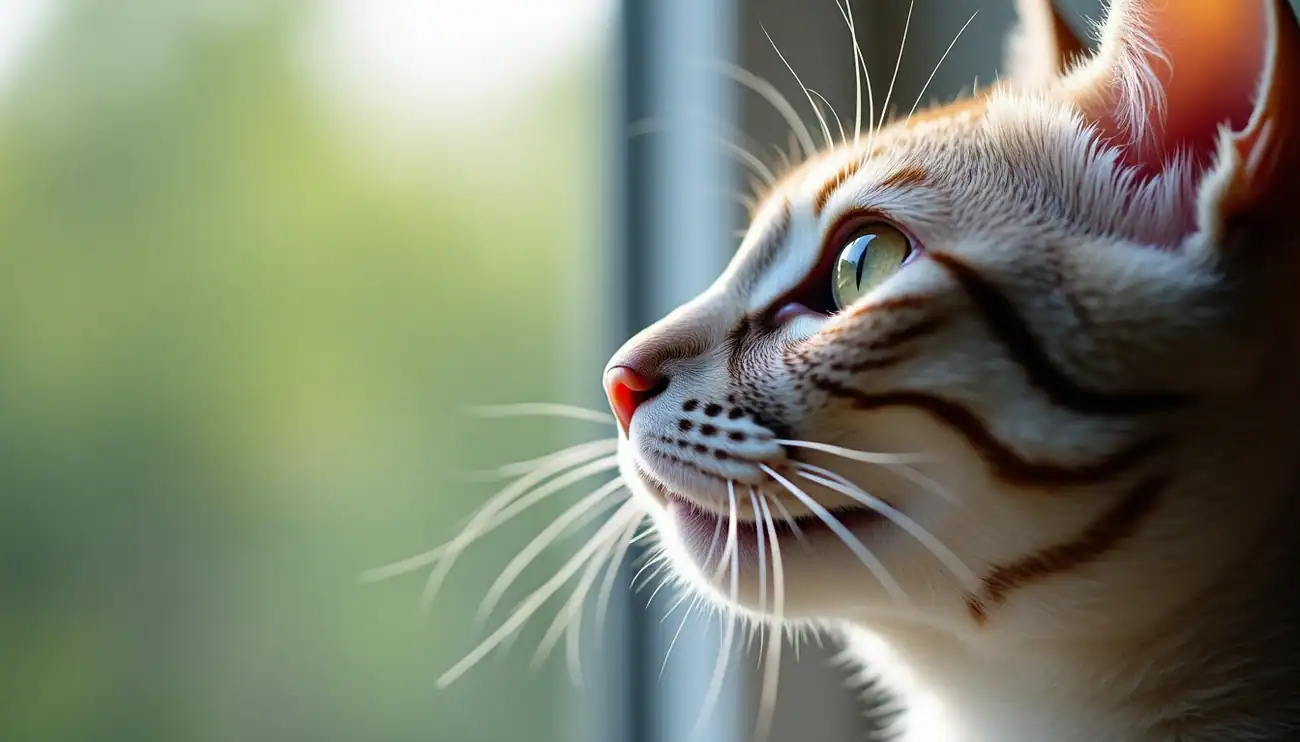
Cat whiskers do much more than decorate their faces—these remarkable hairs work as a sophisticated sensory system that guides felines through their world. Scientists call them vibrissae: long, thick, flexible hairs packed with tiny, sensitive nerves that detect the slightest environmental changes. Each whisker embeds deeply into a specialized follicle, surrounded by 100-200 primary nerve cells that send vital information to the brain.
These sensory tools position themselves with precision to help navigation. A cat’s whiskers usually align with its body width, which lets them judge whether they’ll fit through tight spaces. The whiskers also detect air vibrations, making them valuable tools to measure distances or track prey. Many cat owners ask about damaged whiskers—good news from the American Association of Feline Practitioners confirms that whiskers grow back naturally.
This piece explores the fascinating structure of cat whiskers, their role as sensory tools, and ways to properly care for your feline friend’s whiskers.
Anatomy of Cat Whiskers: Structure and Placement
Cat whiskers differ significantly from regular fur. Their anatomy shows specialized hairs called
vibrissae that embed themselves three times deeper into the skin. The follicles contain an intricate network of nerves and blood vessels that make these structures work as sensory organs rather than just thicker hairs.
A cat’s face features about 24 whiskers arranged in perfect symmetry. The most noticeable ones are the
mystacial whiskers, with twelve whiskers on each side of the upper lip that form four distinct rows. Their faces also feature
superciliary whiskers above each eye (usually two),
genal whiskers on their cheeks, and
mandibular whiskers on their chin.
These fascinating creatures have whiskers in unexpected places too.
Carpal whiskers or carpal vibrissae grow on their front legs’ back near the equivalent of our wrists. These leg whiskers grow longer and thicker than the facial ones and help cats detect prey movements during hunting.
The whisker structure shows remarkable complexity. Each one grows from a specialized follicle that contains a blood-filled capsule known as a blood sinus. This follicle connects to 100-200 primary afferent nerve cells that serve even more mechanoreceptors. The facial whiskers’ arrangement creates a distinctive grid-like pattern with horizontal rows and vertical arcs. This pattern makes each cat’s whisker arrangement as unique as a human’s fingerprints.
How Whiskers Help Cats Sense the World
Cat whiskers act as sophisticated radar systems that work through their extreme sensitivity to vibrations. Each whisker’s proprioceptors send detailed sensory messages to the brain about position, movement, and environmental changes.
These remarkable tactile hairs can detect the slightest air currents, which helps cats move confidently in total darkness. They avoid obstacles by sensing changes in air flow that bounces off objects—similar to echolocation.
A cat’s whiskers can detect movements just 1/2000th the width of a human hair. This incredible sensitivity lets them detect nearby prey even in poor visibility. The carpal whiskers on their front legs boost hunting success by detecting prey movement during captures.
Whiskers do more than help with physical movement – they show emotions clearly. A cat’s whiskers point forward and fan out during curious or alert states. They extend forward while hunting to maximize sensory input. The whiskers pull back against the face as fear or anxiety grows.
Cat whiskers work with other senses to make up for their farsightedness. Cats have trouble focusing on nearby objects, so their whiskers provide vital tactile information about items right under their nose. These sensory tools also help cats keep their balance through proprioception, which adds to their remarkable skill of landing on their feet.
Whisker Health, Damage, and Regrowth
Cat whiskers require proper care beyond understanding their basic function. The whiskers naturally shed and regrow through a cycle like fur. Cats typically lose one or two whiskers when this natural process occurs. A cat’s age, health, and genetics determine the regrowth period, which ranges from six weeks to three months.
Whiskers play a vital role yet remain susceptible to damage. You should
never trim your cat’s whiskers because this disrupts their spatial awareness. The whisker itself has no nerves, so cutting doesn’t cause physical pain, but it substantially impairs your cat’s ability to guide themselves through their environment.
Whisker fatigue affects many cats when their whiskers become overstimulated from repeated contact with objects, especially food bowls. Your cat might paw food onto the floor, act hungry but avoid eating from bowls, or show stress during mealtimes. Each whisker follicle’s connection to 100-200 nerve cells causes this condition by transmitting constant sensory information.
Wide, shallow food and water bowls help prevent whisker fatigue. Your cat can eat comfortably when their sensitive whiskers don’t touch the bowl’s sides. Research on whisker fatigue shows mixed results, yet cats prefer whisker-friendly dishes.
Your veterinarian should examine your cat if multiple whiskers fall out at once or appear broken, as these symptoms might indicate health problems.
Conclusion
Our deep dive into cat whiskers anatomy shows these amazing structures do much more than just decorate a cat’s face. These whiskers work as a complex sensory system that lets cats see their world with incredible precision. Their specialized vibrissae sit deep in nerve-rich follicles and work like environmental radar systems. They pick up the tiniest air currents and vibrations.
Each set of whiskers has its own job. The facial ones help cats know where they are in space. The carpal whiskers on their front legs make them better hunters. This clever setup helps cats direct themselves in the dark, figure out which gaps they can fit through, and catch prey with amazing accuracy.
Cats naturally lose and regrow their whiskers in cycles. You should never cut them. A trim won’t hurt physically but will hurt your cat’s ability to sense their world. Whisker fatigue is real, and you can help prevent it by choosing the right food bowls.
Watch your cat’s whiskers move as they explore. You’ll see a complex sensory network in action. These touch-sensitive hairs are nature’s elegant design that helps cats process vital information about their surroundings. They keep their balance and show how they feel. Cat whiskers are evidence of the amazing changes that help our feline friends thrive in their world.